Showing posts with label Animal. Show all posts

Controversy Surrounds Liger Cubs

Friday, 20 August 2010

LigerTwo newborn liger cubs have been unveiled at a private zoo in Taiwan.

Animal rights groups on the island have criticised the zoo's owner for illegally crossbreeding two different species of protected animals.

Local authorities said Huang Kuo-nan, owner of the World Snake King Education Farm in Tainan County, faces a £1,000 fine for violating the Wildlife Conservation Law by allowing a male African lion and female Bengali tiger to mate.

Footage broadcast by Taiwanese channel TTV showed the two liger cubs curled up in their basket and being tended to by vets and zoo workers.

Mr Huang said three cubs had been born in the litter but only two survived.

He said he did not breed the animals on purpose but admitted he kept the lion and tiger in the same cage for many years, saying: "We tried to separate the lion from the tiger, but it didn't work, because the lion got very angry."

[Source]
READ MORE - Controversy Surrounds Liger Cubs

Top 10 Ugliest Creatures

Wednesday, 11 August 2010

In this list I am talking about physical ugliness, not internal, so don’t even bother mentioning your most hated left or right wing politician or celebrity in the comments (I know you want to). The list does not include insects – they are a whole other level of ugliness! So, from the least ugly to the most revolting, natures 10 ugliest creatures.10. Mata Mata

Mata Mata

The mata mata is a freshwater turtle found predominantly in South America, notably in the Amazon and Orinoco basins. The animal’s peculiar physical aspect distinguishes it from other members of its order. It is an animal highly skilled in hunting techniques. French naturalist, Pierre Barrère described it thus :
“large land turtle with spiky
and ridged scales”. The mata mata is quite visually distinctive: its head is triangular, large, and extremely flattened, with many tubercles and flaps of skin, most notably a ‘horn’ on the nose. There are two barbels on the chin and two additional filamentous barbels at the jaw. The snout is long and tubular. The upper jaw is neither hooked nor notched.
9. Horseshoe Bat

Horseshoe Bat

Horseshoe bats (the Rhinolophidae family) are a large family of bats including approximately 130 species grouped in 10 genera. All rhinolophids have leaf-like protuberances on their noses. In rhinolophines species, these take the shape of a horseshoe; in hipposiderine, they are leaf- or spear-like. They emit echolocation calls through these structures, which may serve to focus the sound. Most rhinolophids are dull brown or reddish brown in color. They vary in size from small to moderately large.

8. Star Nosed Mole

Star Nosed Mole

The Star-nosed Mole is a small North American mole found in eastern Canada and the north-eastern United States. It lives in wet lowland areas and eats small invertebrates, aquatic insects, worms and molluscs. It is a good swimmer and can forage along the bottoms of streams and ponds. Like other moles, this animal digs shallow surface tunnels for foraging; often, these tunnels exit underwater. It is active day and night and remains active in winter, when it has been observed tunnelling through the snow and swimming in ice-covered streams.

7. Sloth

Sloth

Sloths are medium-sized mammals that live in Central and South America. Sloths are omnivores. They may eat insects, small lizards and carrion, but their diet consists mostly of buds, tender shoots, and leaves. Sloth fur also exhibits specialized functions: the outer hairs grow in a direction opposite from that of other mammals. In most mammals, hairs grow toward the extremities, but because sloths spend so much time with their legs above their bodies, their hairs grow away from the extremities in order to provide protection from the elements while the sloth hangs upside down.

6. Naked Mole Rat

Naked Mole Rat

The Naked Mole Rat, also known as the Sand Puppy, or Desert Mole Rat, is a burrowing rodent native to parts of East Africa. Typical individuals are 8–10 cm long and weigh 30–35 g. Queens are larger and may weigh well over 50 g, the largest reaching 80 g. They are well-adapted for their underground existence. Their eyes are just narrow slits, and consequently their eyesight is poor. However, they are highly adapted to moving underground, and can move backwards as fast as they move forwards. Their large, protruding teeth are used to dig. Their lips are sealed just behind their teeth while digging to avoid filling their mouths with soil. Their legs are thin and short. They have little hair (hence the common name) and wrinkled pink or yellowish skin.

5. Axolotl
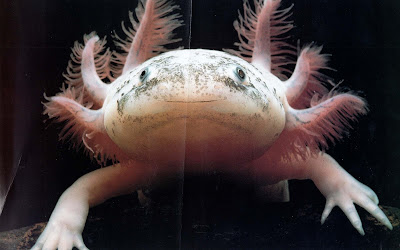
Axolotl

The Axolotl (or ajolote) is the best-known of the Mexican neotenic mole salamanders belonging to the Tiger Salamander complex. Larvae of this species fail to undergo metamorphosis, so the adults remain aquatic and gilled. Their heads are wide, and their eyes are lidless. Their limbs are underdeveloped and possess long, thin digits. Axolotls have barely visible vestigial teeth which would have developed during metamorphosis. The primary method of feeding is by suction, during which their rakers interlock to close the gill slits. Axolotls have 4 different colours, 2 naturally occurring colours and 2 mutants. The 2 naturally occurring colours are wildtype (Varying shades of brown usually with spots) and melanoid (black). The 2 mutants colours are leucistic (pale pink with black eyes) and albino (golden, tan or pale pink with pink eyes).

4. Tarsier
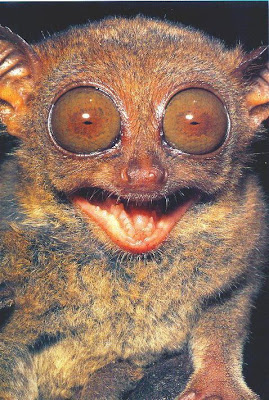
Tarsier

Tarsiers are prosimian primates of the genus Tarsius. Tarsiers have enormous eyes and long feet. Their feet have extremely elongated tarsus bones, which is how they got their name. They are primarily insectivorous, and catch insects by jumping at them. They are also known to prey on birds and snakes. As they jump from tree to tree, tarsiers can catch even birds in motion. Tarsiers have never formed successful breeding colonies in captivity, and when caged, tarsiers have been known to injure and even kill themselves because of the stress.

3. Hagfish


Despite their name, there is some debate about whether Hagfish are strictly fish, since they belong to a much more primitive lineage than any other group that is commonly defined fish. Hagfish are long, vermiform and can exude copious quantities of a sticky slime or mucus. When captured and held by the tail, they escape by secreting the fibrous slime, which turns into a thick and sticky gel when combined with water, and then cleaning off by tying themselves in an overhand knot which works its way from the head to the tail of the animal, scraping off the slime as it goes. Hagfish have elongated, ‘eel-like’ bodies, and paddle-like tails.

2. Aye-aye
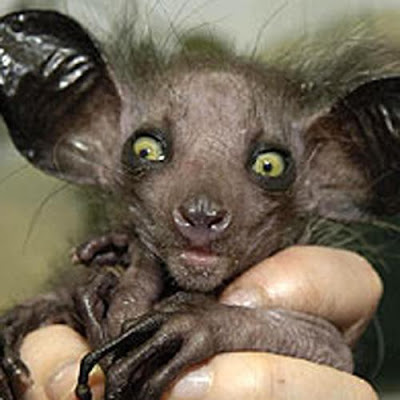
Aye-aye

The Aye-aye is a native to Madagascar that combines rodent-like teeth with a long, thin middle finger to fill the same ecological niche as a woodpecker. The Aye-aye is the world’s largest nocturnal primate, and dwells predominantly in forest canopies. The adult Aye-aye has black or dark brown fur covered by white guard hairs at the neck. The tail is bushy and shaped like that of a squirrel. The Aye-aye’s face is also rodent-like, the shape of a raccoon’s, and houses bright, beady, luminous eyes. Its incisors are very large, and grow continuously throughout its lifespan.

1. Blobfish

Blobfish

The Blobfish inhabits the deep waters off the coasts of Australia and Tasmania. Due to the inaccessibility of its habitat, it’s rarely seen by humans. Blobfish are found at depths where the pressure is several dozens of times higher than at sea level. To remain buoyant, the flesh of the Blobfish is primarily a gelatinous mass with a density slightly less than water; which allows the fish to float above the sea floor without expending energy on swimming. The relative lack of muscle is not a disadvantage as it primarily swallows edible matter that floats by in front it.

[Source : Listverse]
READ MORE - Top 10 Ugliest Creatures

10 Amazing Animal Facts

Tuesday, 27 July 2010

The animal kingdom has long been a mysterious one for humans and every day we learn something new about it. This is a list of ten little known facts about animals.

10. Crocodiles Eat Stones

Crocodiles Eat Stones
The stomach of a crocodile is a rocky place to be, for more than one reason. To begin with, a croc’s digestive system encounters everything from turtles, fish and birds to giraffes, buffaloes, lions and even (when defending territory) other crocodiles. In addition to that bellyful-o’-ecosystem, rocks show up too. The reptiles swallow large stones that stay permanently in their bellies. It’s been suggested these are used for ballast in diving.


9. Whale Milk is 50% Fat

Whale Milk is 50% Fat

Nursing a newborn is no “small” feat for the whale, whose calf emerges, after 10 to 12 months in the womb, about a third the mother’s length (that’s a 30-foot baby for the Blue whale). The mother squirts milk into the newborn’s mouth using muscles around the mammary gland while the baby holds tight to a nipple (yes, whales have them). At nearly 50 percent fat, whale milk has around 10 times the fat content of human milk, which helps calves achieve some serious growth spurtseas much as 200 pounds per day.


8. Birds Recognize Landmarks

Birds Recognize Landmarks

Can you imagine a road trip vacation without missed exits, stubborn drivers or map-folding disasters? Of course noteyou’re not a bird. Pigeons can fly thousands of miles to find the same roosting spot with no navigational difficulties. Some species of birds, like the Arctic tern, make a 25,000 mile round-trip journey every year. Many species use built-in ferromagnets to detect their orientation with respect to the Earth’s magnetic field. A November 2006 study published in Animal Behaviour suggests that pigeons also use familiar landmarks on the ground below to help find their way home


7. Beavers have Longer Days in Winter

Beavers have Longer Days in Winter

Beavers become near shut-ins during winter, living off of previously stored food or the deposits of fat in their distinctive tails. They conserve energy by avoiding the cold outdoors, opting instead to remain in dark lodgings inside their pile of wood and mud. As a result these rodents, which normally emerge at sunset and turn in at sunrise, have no light cues to entrain their sleep cycle. The beaver’s biological sense of time shifts, and she develops a “free running circadian rhythm” of 29-hour days.

6. Mole-Rats are not Blind

Mole-Rats are not Blind

With their puny eyes and underground lifestyle, African mole-rats have long been considered the Mr. Magoos of rodents, detecting little light and, it has been suggested, using their eyes more for sensing changes in air currents than for actual vision. But findings of the past few years have shown that African mole-rats have a keen, if limited, sense of sight. And they don’t like what they see, according to a report in the November 2006 Animal Behaviour. Light may suggest that a predator has broken into a tunnel, which could explain why subterranean diggers developed sight in the first place.


5. Baby Chicks are Altruistic

Baby Chicks are Altruistic

It’s a mistake to think of evolution as producing selfish animals concerned only with their own survival. Altruism abounds in cases where a helping hand will encourage the survival of genetic material similar to one’s own. Baby chicks practice this “kin selection” by making a special chirp while feeding. This call announces the food find to nearby chicks, who are probably close relations and so share many of the chick’s genes. The key to natural selection isn’t survival of the fittest animal. It’s survival of the fittest genetic material, and so brotherly behavior that favors close relations will thrive.


4. Many Fish Swap Sex Organs

Many Fish Swap Sex Organs

With so many land creatures to wonder at, it’s easy to forget that some of the weirdest activities take place deep in the ocean. The strange practice of hermaphroditism is more common among species of fish than within any other group of vertebrates. Some fish change sex in response to hormonal cycle or environmental changes. Others simultaneously possess both male and female sex organs.


3. Giraffes have Unique Blood Flow

Giraffes have Unique Blood Flow

The stately giraffe, whose head sits some 16 feet up atop an unlikely pedestal, adapted his long neck to compete for foliage with other grazers. While the advantage of reach is obvious, some difficulties arise at such a height. The heart must pump twice as hard as a cow’s to get blood up to the brain, and a complex blood vessel system is needed to ensure that blood doesn’t rush to the head when bent over. Six feet below the heart, the skin of the legs must then be extremely tight to prevent blood from pooling at the hooves.

2. Elephants are Smart

Elephants are Smart

Elephants have the largest brain, nearly 11 pounds on average of any mammal that ever walked the earth. Do they use that gray matter to the fullest? Intelligence is hard to quantify in humans or animals, but the encephalization quotient (EQ), a ratio of an animal’s observed brain size to the expected brain size given the animal’s mass, correlates well with an ability to navigate novel challenges and obstacles. The average elephant EQ is 1.88. (Humans range from 7.33 to 7.69, chimpanzees average 2.45, pigs 0.27.) Intelligence and memory are thought to go hand in hand, suggesting that elephant memories, while not infallible, are quite good.


1. Parrots Understand


Parrot speech is commonly regarded as the brainless squawking of a feathered voice recorder. But studies over the past 30 years continually show that parrots engage in much more than mere mimicry. Our avian friends can solve certain linguistic processing tasks as deftly as 4-6 year-old children. Parrots appear to grasp concepts like “same” and “different”, “bigger” and “smaller”, “none” and numbers. Perhaps most interestingly, they can combine labels and phrases in novel ways. A January 2007 study in Language Sciences suggests using patterns of parrot speech learning to develop artificial speech skills in robots.


[Source : Listverse]
READ MORE - 10 Amazing Animal Facts


eXTReMe Tracker